cavum
cav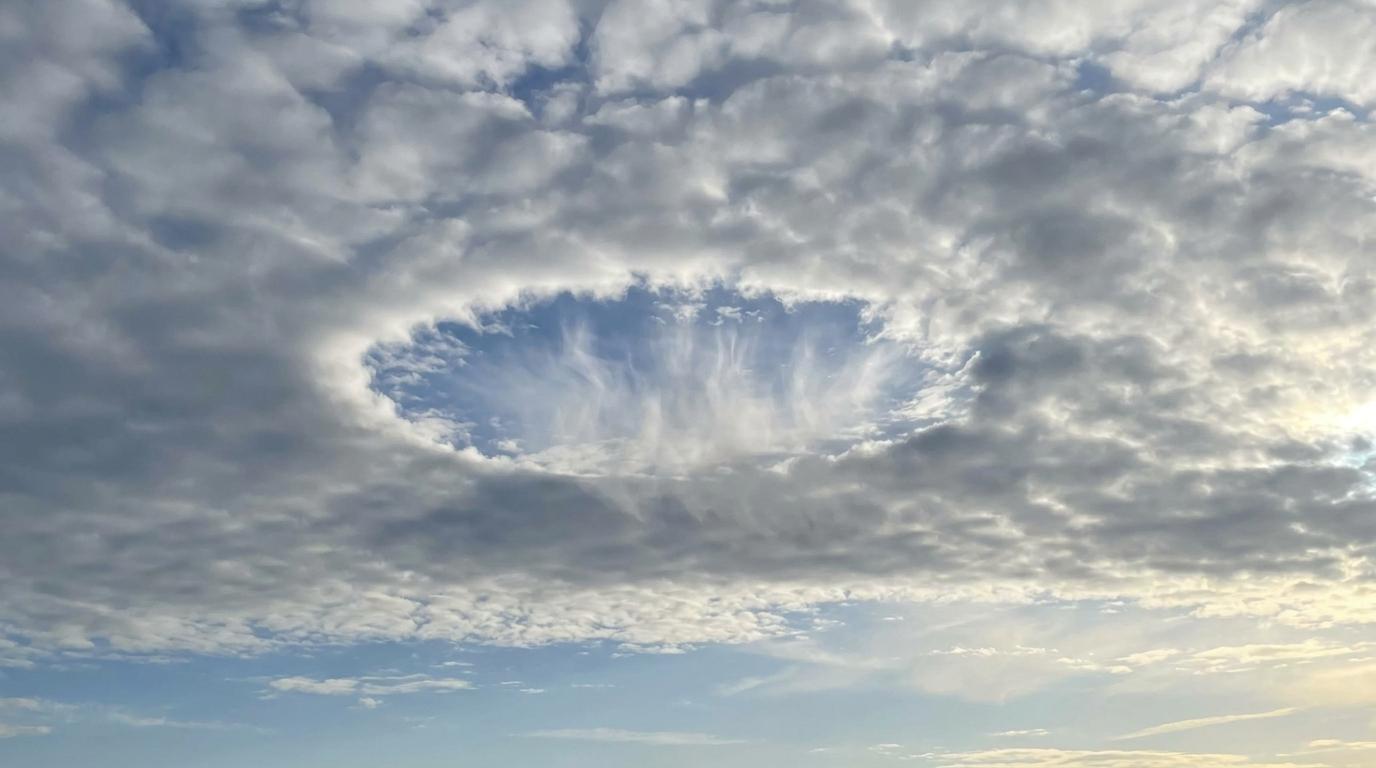
Altocumulus cavum
© wetterkurs.ch
Description
Cavum (lat. "cave" or "hole") is a supplementary feature that appears as a circular or elliptical gap in a thin layer of altocumulus or cirrocumulus. It forms when supercooled water droplets suddenly freeze, grow into larger ice crystals, and fall out as fallstreaks. In the center of the gap, fine, hanging ice crystal streaks (virga) are often visible. This process is frequently triggered by passing aircraft, which is why cavum is also known as a "hole-punch cloud" or "fallstreak hole."
Identification Features
- Circular or elliptical hole in a thin cloud layer
- Occurs mostly in altocumulus or cirrocumulus fields
- Fine veils of ice crystals (virga) often visible inside the gap
- Sharply defined edge at the boundary with the surrounding cloud cover
- Can grow larger over time as the gap expands outward
- Frequently triggered by aircraft, in which case it may also appear linear
- Typically occurs at temperatures below -5 °C within the cloud layer
Related genera
cavum is not a distinct cloud type, but a supplementary feature that is given in addition to the genus name. It can occur with the following genera: Ac, Cc, Sc.
Meteorological Significance
Cavum indicates the presence of a supercooled cloud layer in which liquid droplets exist at temperatures below freezing. The phenomenon itself has little direct impact on weather, but provides an interesting glimpse into the microphysical processes taking place in the atmosphere. Its appearance can indicate the approach of a warm front or a changing weather situation. For short-term weather forecasting, cavum is not particularly informative — it is more of an optical phenomenon with considerable aesthetic appeal.
Facts
- WMO-Code
- cav
- Height layer
- High clouds
- Typical height
- 5.0 - 13.0 km
- Genus
- CIRROCUMULUS