mamma
mam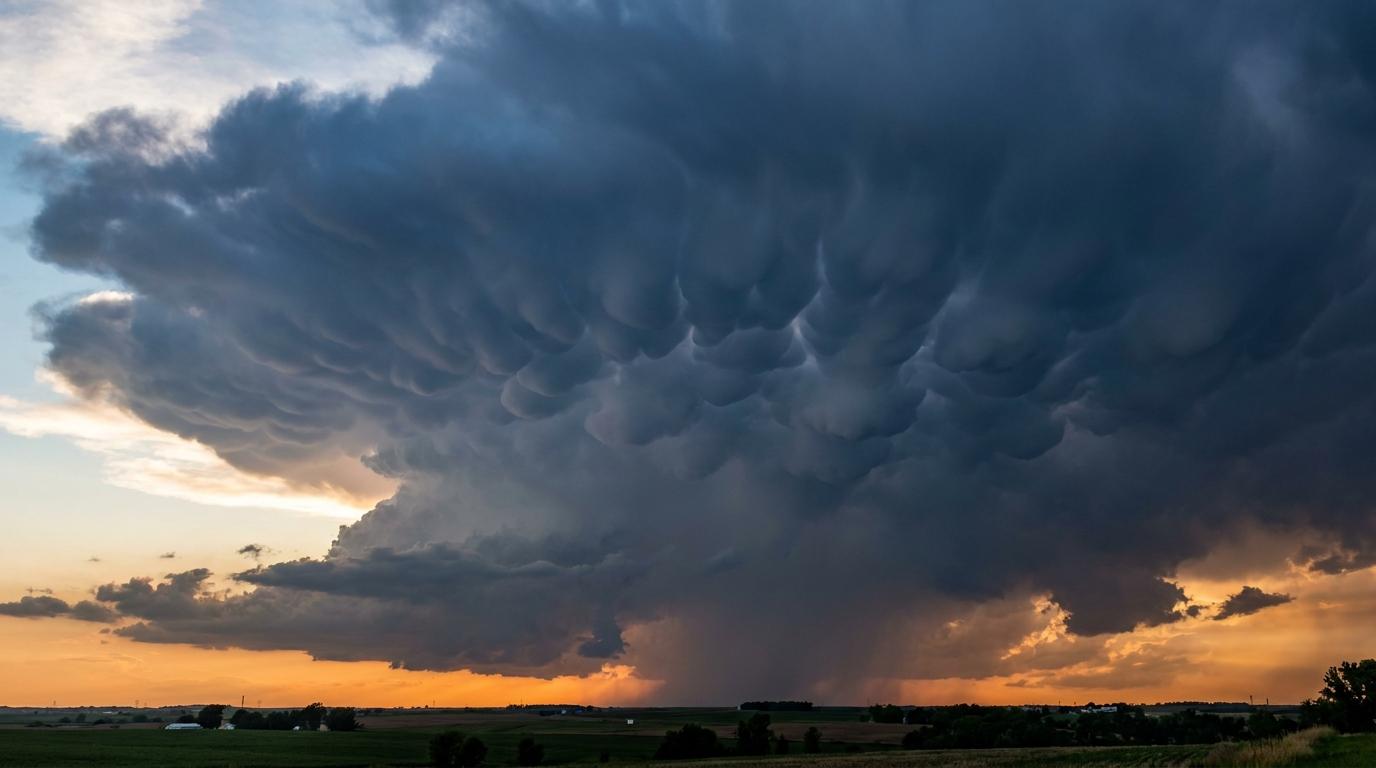
Cumulonimbus mamma
© wetterkurs.ch
Description
The name "mamma" (Latin for breast, udder) describes the characteristic pouch-like, downward-hanging protrusions on the underside of a cloud. Mamma is an accessory feature rather than a standalone cloud type, occurring most frequently beneath the anvil of a cumulonimbus, and occasionally associated with cirrus, cirrocumulus, altocumulus, altostratus, or stratocumulus. The rounded pouches form when descending, cooled air parcels laden with ice crystals or water droplets bulge downward against the warmer surrounding air. Mamma often appear in dramatic form when the sun is low on the horizon and are considered one of the most visually striking atmospheric phenomena.
Identification Features
- Pouch-like, bag-shaped protrusions on the underside of a cloud
- Typically occur in groups, spread across a wide area side by side
- Most commonly found beneath the anvil (incus) of a cumulonimbus
- Smooth, rounded or droplet-shaped contours
- Often particularly high-contrast in low sunlight (yellowish-orange to gray)
- Typically appear after the passage of a thunderstorm cell
- Can also occur on cirrus, altocumulus, or stratocumulus
Related genera
mamma is not a distinct cloud type, but a supplementary feature that is given in addition to the genus name. It can occur with the following genera: Ci, Cc, Ac, As, Sc, Cb.
Meteorological Significance
Mamma are indicators of strong turbulence and atmospheric instability, as they make descending, cold, and moist air parcels visible. When they appear beneath a cumulonimbus anvil, they point to a particularly intense thunderstorm cell, though they often become visible only after the heaviest precipitation has passed. In association with supercells, they can indicate the potential for hail, severe wind gusts, or, rarely, tornadoes. For ground-level observers, mamma do not themselves produce precipitation, but signal that a significant thunderstorm is prevailing or has just passed through.
Facts
- WMO-Code
- mam
- Height layer
- Vertical clouds
- Typical height
- 0.5 - 3.0 km
- Genus
- CUMULONIMBUS