Cirrocumulus lacunosus
Cc la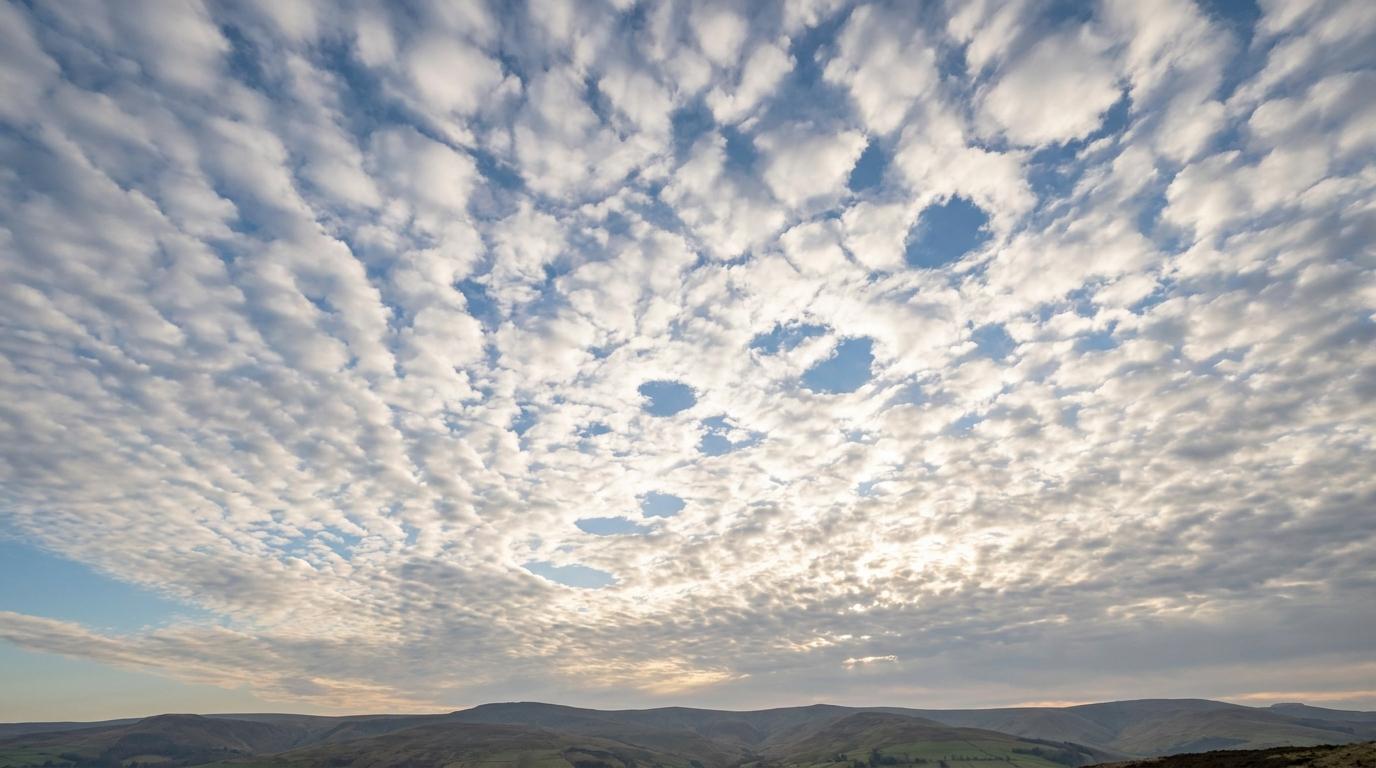
Cirrocumulus lacunosus
© wetterkurs.ch
Description
The name "lacunosus" (Latin: full of holes, gap-ridden) describes a cloud variety in which the cloud layer is interspersed with regular, round holes or gaps, creating a net- or honeycomb-like pattern. Cirrocumulus lacunosus forms at great altitude and consists entirely of ice crystals. The holes in the cloud cover are created by local descending air that dissolves the cloud material, while the surrounding areas remain intact. This variety is relatively rare and ranks among the most impressive appearances in the high sky. The pattern resembles a honeycomb or lace network and can produce spectacular optical effects under favorable sunlight conditions.
Identification Features
- Thin, high cloud layer with regular, round holes or gaps
- Net-, honeycomb-, or lace-like appearance
- The holes are mostly round or oval and relatively evenly distributed
- Cloud elements consist of very small, granular patches or globules
- Appears at typical cirrocumulus altitudes above 6,000 meters
- Individual cloud elements are smaller than 1 degree of angular extent (little finger at arm's length)
- No shading visible on the underside, as the layer is very thin
- Clear distinction from altocumulus lacunosus due to the smaller size of the elements and greater altitude
Occurrence by genus
Highlighted: all genera with which lacunosus occurs.
Meteorological Significance
Cirrocumulus lacunosus indicates moisture layers at great altitude in which small-scale vertical air movements are occurring. Its appearance can signal an impending change in weather conditions, particularly when the cloud cover thickens or spreads into lower layers. As an isolated phenomenon, however, cirrocumulus lacunosus often has no immediate significance for surface weather. In combination with other cloud types, such as increasing cirrostratus, it can be a harbinger of an approaching frontal system. The cloud is generally short-lived and frequently dissipates again within a few minutes.
Facts
- WMO-Code
- Cc la
- Height layer
- High clouds
- Typical height
- 6.0 - 12.0 km
- Genus
- CIRROCUMULUS