Stratocumulus translucidus
Sc tr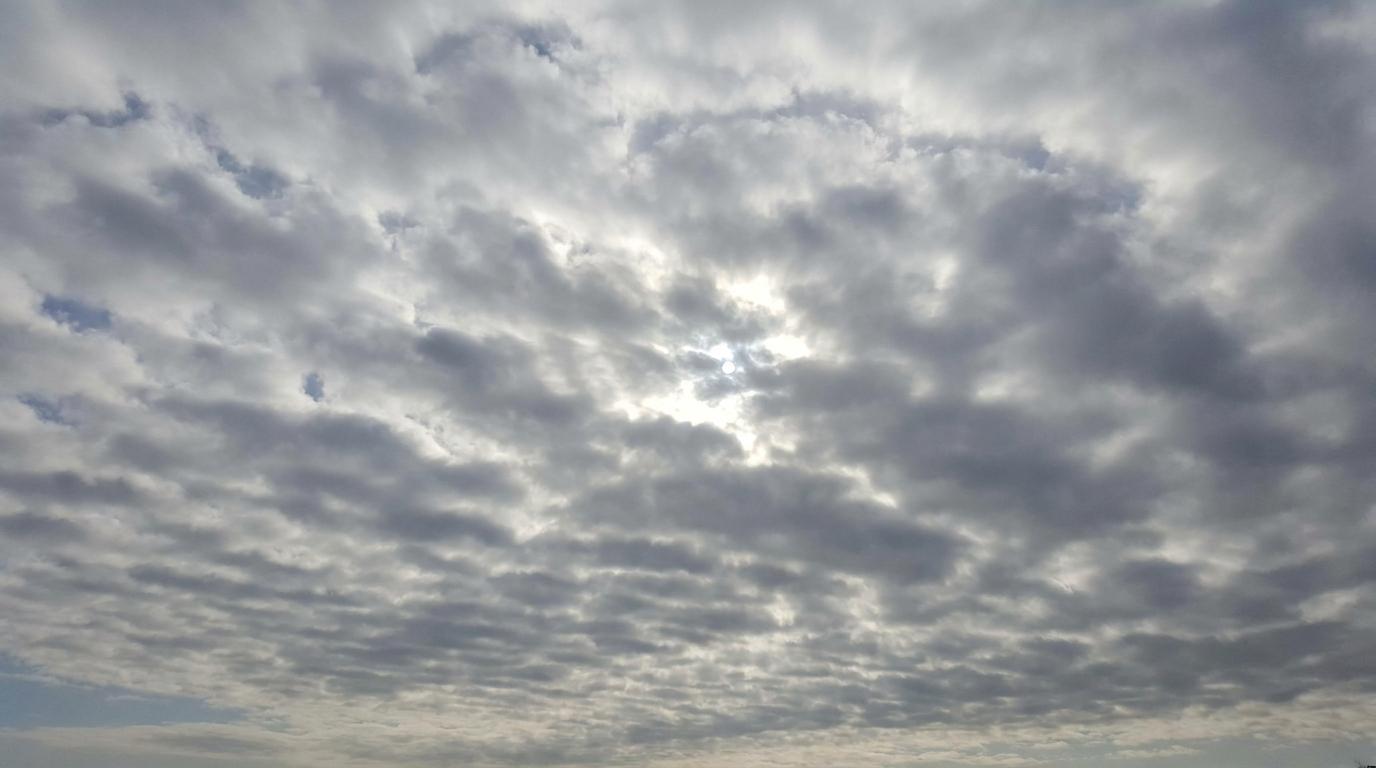
Stratocumulus translucidus
© wetterkurs.ch
Description
The variety "translucidus" (Latin: translucent) refers to cloud fields through which the position of the sun or moon remains visible. Stratocumulus translucidus forms an extensive layer of flat, rounded cloud masses or rolls that is thin enough to allow sunlight to pass through. The clouds often appear as a uniformly structured cover with brighter and darker areas, with the sky potentially showing through between individual elements. This variety frequently occurs in temperate latitudes, especially during the cooler seasons, and is one of the most widespread cloud forms worldwide. The layer conveys an overall milky-bright impression, as sunlight is diffusely scattered.
Identification Features
- Extensive, flat cloud layer of rounded masses, patches, or rolls at low altitude
- The sun or moon is visible through the cloud layer, albeit veiled
- The cloud elements are thin enough that the sky shows through in places
- Brighter spots in the cloud cover indicate the position of the sun
- Color tones vary from white to light grey, rarely dark grey
- A distinct wavy or grainy structure of the layer is visible
- Base typically lies below 2,000 meters
- Distinguished from Altocumulus translucidus by its lower altitude and larger individual elements
Occurrence by genus
Highlighted: all genera with which translucidus occurs.
Meteorological Significance
Stratocumulus translucidus indicates a stable atmosphere with a weak inversion layer at low altitude. This cloud form generally brings no significant precipitation; at most, light drizzle is possible. It frequently occurs during weak high-pressure situations or at their margins, when moist air in the lower troposphere is prevented from rising by a temperature inversion. The sun showing through indicates that the layer is relatively thin, suggesting an imminent dissipation or at least no deterioration of weather conditions. With increasing influence of a high-pressure system, the layer often breaks up during the course of the day due to surface heating.
Facts
- WMO-Code
- Sc tr
- Height layer
- Low clouds
- Typical height
- 0.6 - 2.0 km
- Genus
- STRATOCUMULUS