Stratocumulus undulatus
Sc un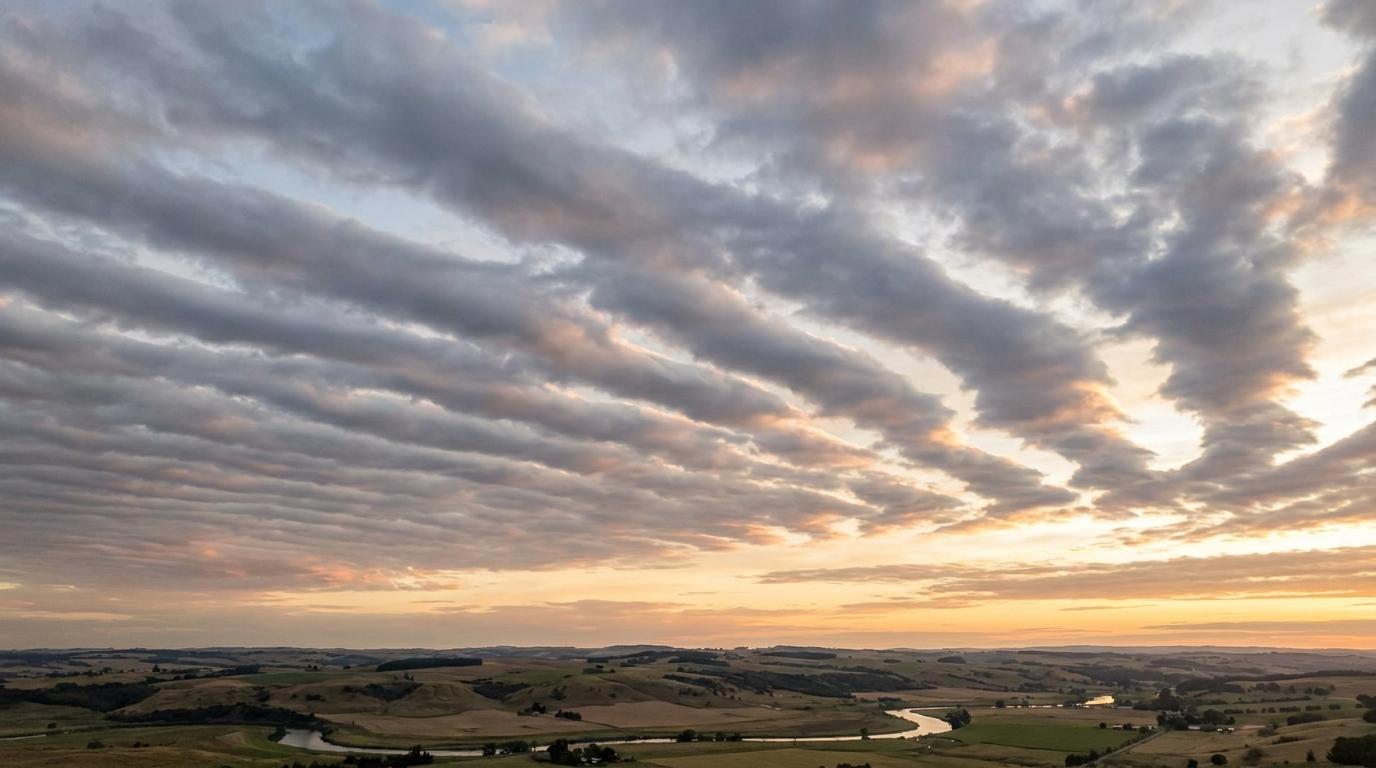
Stratocumulus undulatus
© wetterkurs.ch
Description
The name "undulatus" (Latin: wave-shaped) describes a variety of stratocumulus in which the cloud elements are arranged in clearly recognizable, parallel waves or rows. This undulating structure is caused by wind shear at the interface between two air layers of differing speed or density, similar to waves on a water surface. Stratocumulus undulatus often forms an impressive, regular striped pattern in the sky that can cover large areas. The wave crests and wave troughs alternate, creating a rhythmic alternation between denser and thinner cloud portions. This cloud form is one of the most common appearances in the sky and occurs preferentially in stable air layers with moderate humidity.
Identification Features
- Clearly recognizable, parallel wave pattern in the cloud cover
- Regular succession of denser cloud bands and brighter gaps
- Cloud base typically lies low, often between 600 and 2,000 meters
- The wave structure frequently extends across large sections of sky
- Gray to whitish coloration with discernible shading in the wave troughs
- The wave lines usually run perpendicular to the prevailing wind direction at cloud level
- Individual cloud elements are larger than in altocumulus (apparent diameter greater than 5 degrees)
- Can occur as both a closed and a broken cloud cover
Occurrence by genus
Highlighted: all genera with which undulatus occurs.
Meteorological Significance
Stratocumulus undulatus indicates the presence of wind shear in the lower troposphere, suggesting different air masses or flow conditions at low altitude. This cloud form is frequently associated with stable weather patterns and generally brings no precipitation or only very light drizzle. The undulating structure can persist for hours and indicates that no major weather changes are imminent. However, if the wave structure breaks down and the cloud cover thickens, this can indicate an approaching disturbance. With increasing instability, convective cloud forms can also develop from stratocumulus undulatus.
Facts
- WMO-Code
- Sc un
- Height layer
- Low clouds
- Typical height
- 0.6 - 2.0 km
- Genus
- STRATOCUMULUS