Cirrus fibratus
Ci fib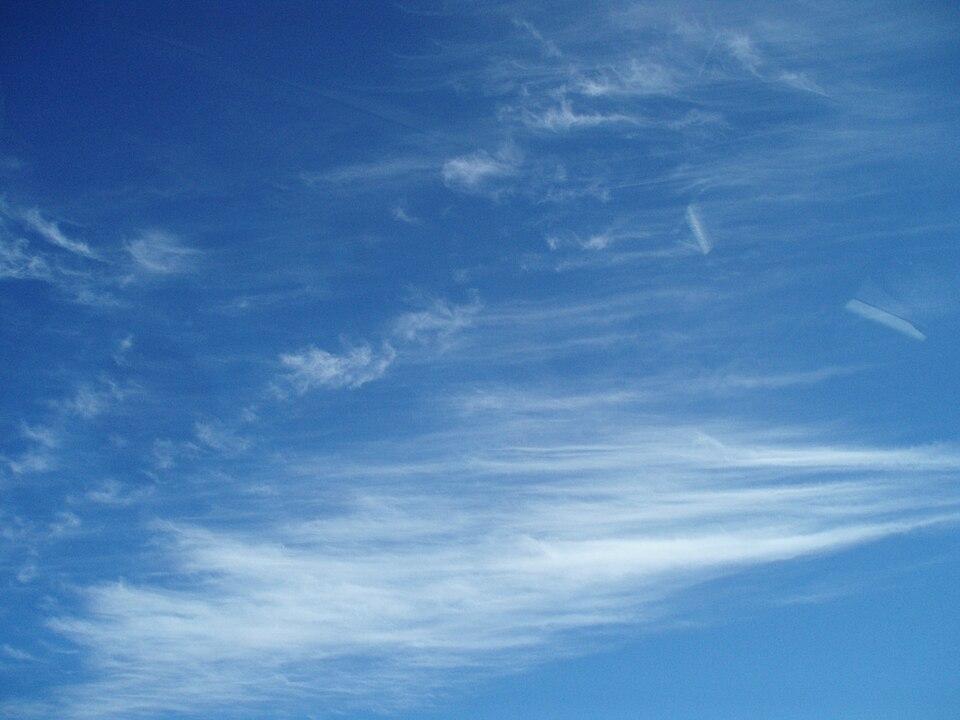
Cirrus fibratus
© Di Eryn Blaire - Opera propria, CC BY 3.0, Wikimedia
Description
The name "fibratus" (Latin: fibrous) describes the characteristic appearance of this species of cirrus: fine, hair-like strands or fibers that extend across the sky in a nearly straight or slightly curved manner. Cirrus fibratus is the most common and most typical species of the genus Cirrus, and consists exclusively of ice crystals that form at great altitude. The individual fibers appear white to silky lustrous and can extend across large portions of the sky without exhibiting distinct thickenings or hooks. Their delicate, almost translucent structure allows sunlight to pass through largely unimpeded and occasionally produces optical phenomena such as halos.
Identification Features
- Fine, hair-like or filamentous cloud fibers without distinct thickenings or hooks
- Nearly straight or gently curved course of the individual fibers
- White to silky lustrous appearance at great altitude
- Clearly separated, non-interwoven individual fibers
- No tufted or flocculent densifications visible
- Very thin and translucent; the blue sky usually remains clearly visible
- Clear distinction from Cirrus uncinus, which displays characteristic hooks or comma shapes
- Can extend across large portions of the sky, often arranged in parallel
Occurrence by genus
Highlighted: all genera with which fibratus occurs.
Meteorological Significance
Cirrus fibratus appearing as isolated, limited streaks generally indicates stable weather and is of little meteorological significance. However, if the fibers rapidly increase in density and extent and consolidate into a continuous cirrostratus layer, this can be an early sign of an approaching warm front. In this case, a deterioration in weather and the onset of precipitation can be expected within 12 to 36 hours. The orientation of the fibers frequently provides information about wind direction in the upper troposphere and can indicate jet stream activity. Isolated, stationary Cirrus fibratus, by contrast, is usually harmless and forms through local moisture fields at great altitude.
Facts
- WMO-Code
- Ci fib
- Height layer
- High clouds
- Typical height
- 6.0 - 12.0 km
- Genus
- CIRRUS