Stratocumulus volutus
Sc vol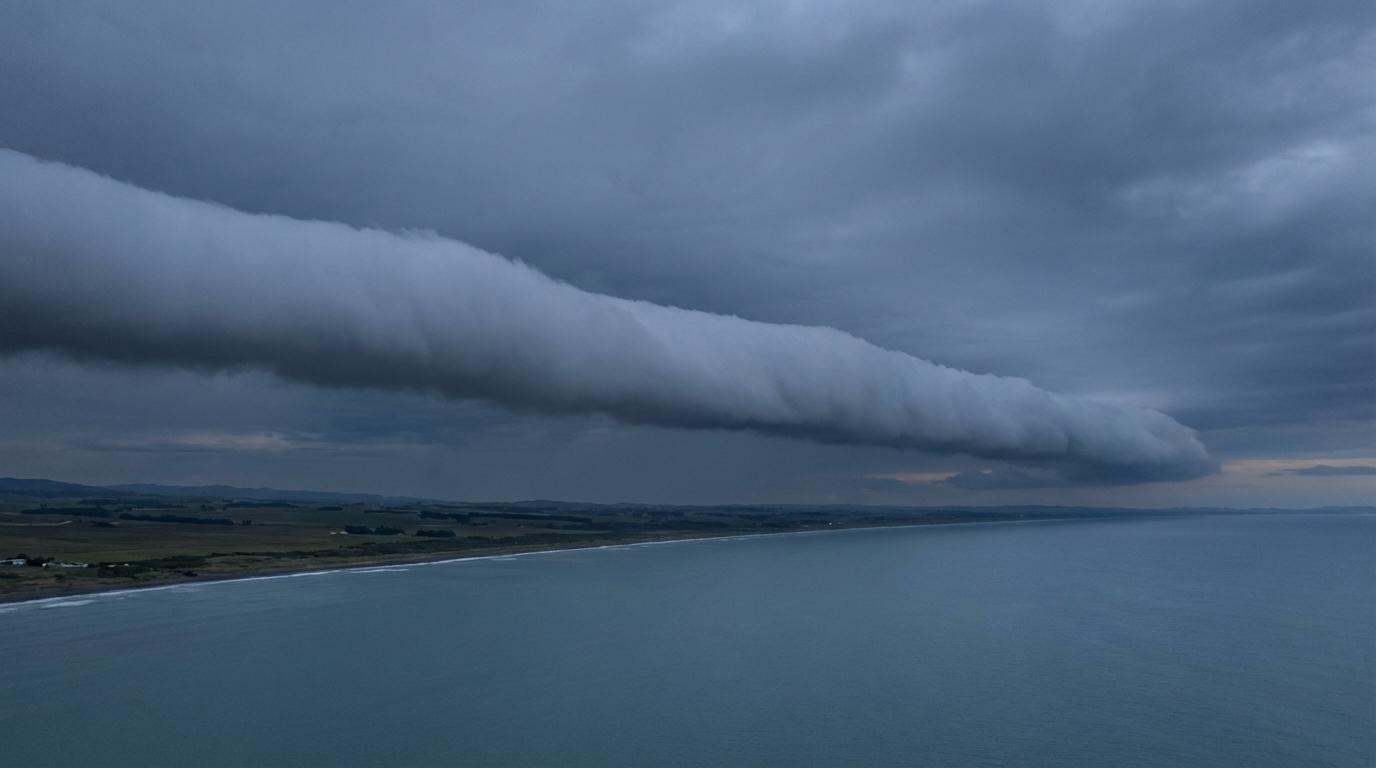
Stratocumulus volutus
© wetterkurs.ch
Description
The name "volutus" (Latin: rolled) describes the characteristic, elongated, tube-shaped cloud that appears to rotate around a horizontal axis. Stratocumulus volutus is a rare and spectacular cloud formation, also known as a "roll cloud." It appears as a single, elongated cylinder in the sky, completely detached from the surrounding cloud cover. This cloud often forms along gust fronts ahead of thunderstorms or through mesoscale wind phenomena such as sea breeze convergences. A well-known recurring example is the "Morning Glory Cloud" in the Gulf of Carpentaria in northern Australia.
Identification Features
- Elongated, cylindrical or tube-shaped cloud that can stretch across the entire horizon
- Appears to slowly rotate around its own horizontal axis
- Completely isolated and detached from other cloud layers, unlike arcus clouds
- Occurs individually or, rarely, in parallel rows
- Typically visible low in the sky, within the low cloud layer
- Can move rapidly across the sky, often at a uniform speed
- No precipitation falls directly from the cloud
- Frequently observed in the early morning hours or in association with gust fronts
Occurrence by genus
Highlighted: all genera with which volutus occurs.
Meteorological Significance
Stratocumulus volutus typically forms at the boundary between air masses of differing temperature and humidity, particularly along gust fronts ahead of approaching thunderstorm systems. Its appearance can therefore indicate imminent stronger wind gusts and possible convective weather development. In tropical coastal regions, it is often associated with nocturnal inversion and breeze circulations, in which case it carries no immediate severe weather significance. The rolling motion is generated and sustained by wind shear in the lower troposphere. In general, the sighting of a roll cloud is considered a rare meteorological phenomenon, indicative of dynamic processes within the boundary layer.
Facts
- WMO-Code
- Sc vol
- Height layer
- Low clouds
- Typical height
- 0.3 - 2.0 km
- Genus
- STRATOCUMULUS